How to Spend 12 hours in Helsinki on a Daytrip from Tallinn
When we started planning our Tallinn itinerary we started looking outside of the city. In fact, we started to look outside of the country. No offence to Estonia. The proximity of Finland to Estonia by ferry made it a no-brainer to take the two-hour trip and tick another capital city off our list. Our third in a week. With such a short time in the Finish capital, here’s how we spent our 12 hours in Helsinki.
**This blog post may contain affiliate links. This means that if you go on to make a purchase or booking after clicking through one of my external links, then I may make a tiny bit of commission, at no extra cost to you!**
Getting from Tallinn to Helsinki by ferry
We travelled to Helsinki by ferry with Tallink Silja Line, on a two hour ferry crossing. There are multiple crossings every day between the two cities. We booked early via Direct Ferries, and selected the ferry leaving Tallinn at 07:30, and departing Helsinki at 19:30, giving us 12 hours in the Finnish capital.
I’ve written more about how to travel by ferry between Tallinn & Helsinki HERE.
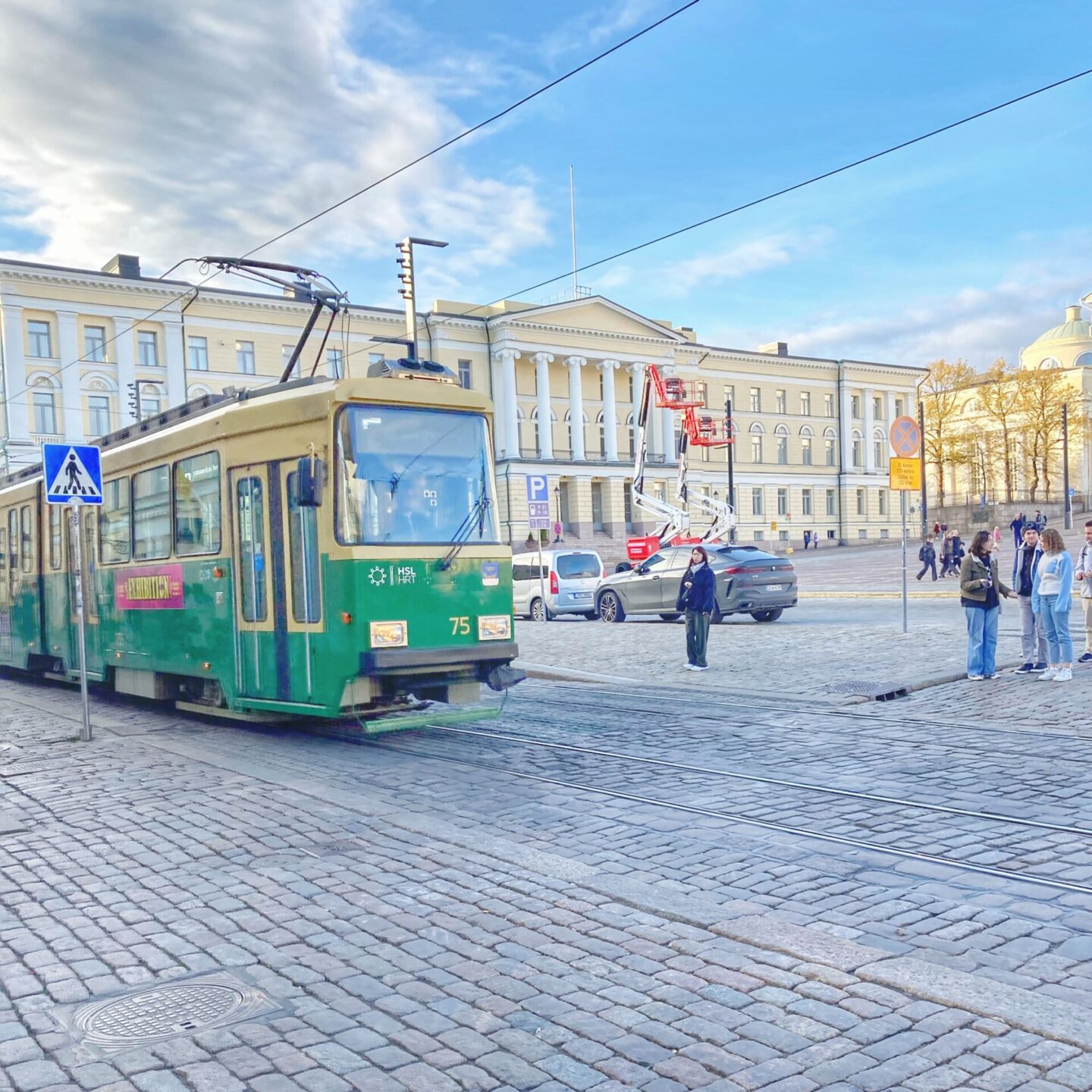
Tallink Silija Line Ferries arrive at West Terminal 2, and from the port, its easy to reach the city centre by tram. We catch Tram 7 to Senaatintori/Senatstorget – stops are listed in both Finnish and Swedish. A tram ticket, valid for 80 minutes, is currently €3,20. You can download the HSL app to purchase tickets or purchase from a ticket machine.

What to do in Helsinki in just 12 hours
The tram from the port drops us at Senate Square just after 10am. We have a lot to see, so regular readers won’t be surprised by the first item on our whirlwind “12 hours in Helsinki” itinerary. Yes, yes, I’m banging on about a free walking tour. AGAIN.
Take a free walking tour
This was our third free walking tour in a week, but with just 12 hours in Helsinki this was the perfect way for us to get a flavour for this quirky capital. We booked this one via Guruwalk as the 10:30am start was perfect, giving us time to travel from the port to the city. We met our guide Medi at the base of Helsinki Cathedral, and over two hours he showed us some of the city’s hotspots as well as sharing quirky facts about the Finnish culture.
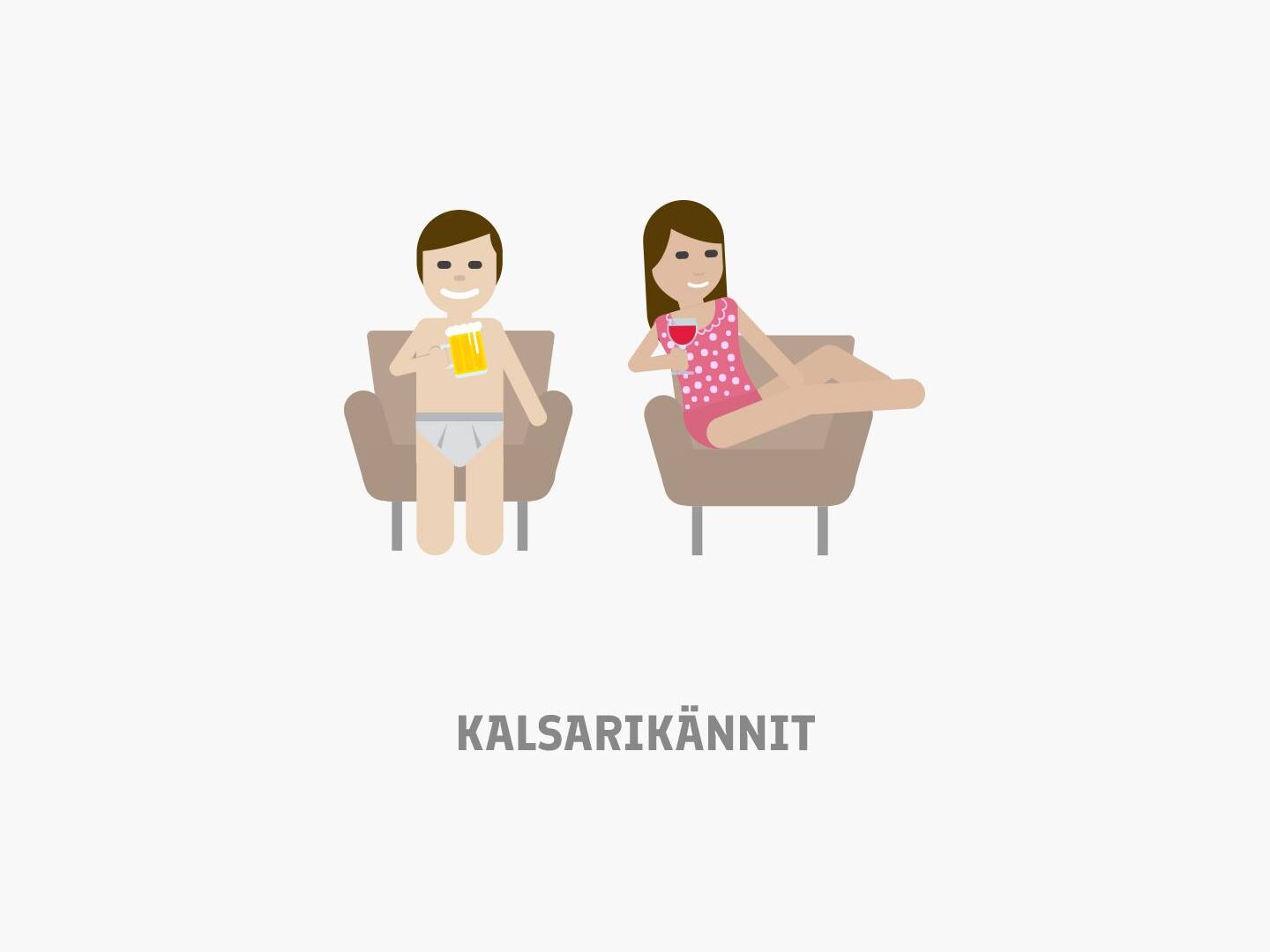
Fun Finnish Facts: The Finnish tradition of drinking at home in your underwear, with no intention to go out, is called “kalsarikännit”. It is loosely translated to “pantsdrunk” in English. Finns even have a kalsarikännit emoji.
Medi is knowledgeable and engaging, with that singsong lilt that we’ve come to expect from this part of the world. He weaves together tales of the past with modern-day living, and really brings Helsinki to life with his storytelling. With such limited time, we appreciated the opportunity to get this great introduction to the city’s history, culture and architecture.
As always with “free” walking tours, make sure you tip generously at the end! A good guide will gently encourage you to donate what you feel the tour may be worth, without putting on any pressure. “Free” tour guides are often freelance and tips could be their sole income – which means they often work harder to give you the best experience possible!
More Fun Finnish Facts: The Wife Carrying World Championships have been held annually in Sonkajärvi, Finland, since 1992. The prize for the winner is the wife’s weight in beer 😂
Helsinki Cathedral & Senate Square:
Senate Square is the historical heart of Helsinki, surrounded by neoclassical buildings. In the centre is a statue of Tsar Alexander II, the Grand Duke of Finland (1818–1881) – Finland’s “Good Tsar” who established some autonomy for the country amid Russian occupation.
Senate Square is the perfect place to start exploring Helsinki, not least because it’s home to the first of Helsinki’s two cathedrals. The Finnish Evangelical Lutheran Cathedral represents the main faith in Finland. This is the one you see in all the photos, a striking white church with five green domes. Make sure you snap a photo in front of the Helsinki sign too for that true tourist experience. Don’t worry, if you miss this one, there’s another one coming up later in the day!

🚻 There are free public toilets on Sofiankatu between Senate Square and Market Square – 📍LOCATION HERE
Helsinki City Museum and the Finns favourite pastime: sauna
Medi pops us all into the free-to-enter Helsinki City Museum for a quick unscheduled visit, and mainly to gather us around a slightly creepy papier mache exhibit of the Finn’s favourite pastime. Yes, the sauna. The sauna (pronounced “sow-na“) is a place to relax, to celebrate, to commiserate, and to connect with others. It turns out that the notoriously introverted (fintroverted?) nation love to socialise with others in a tiny hot room with no clothes on. Births. Weddings. Funerals. Business meetings. First dates. Finns consider sauna to be high up on Maslow’s hierarchy of needs. Somewhere in between safety/security and love/belonging I imagine.
Look away now if you’re of a nervous disposition.

I warned you. There were far more graphic angles that I felt uncomfortable snapping.
If you have more time – or its raining during your day in Helsinki – I would highly recommend spending longer in the Helsinki City Museum. Located on Senate Square, it uses digital methods and immersive displays to represent the changing cultural history of the city through storytelling, photographs and artefacts.
Market Square (Kauppatori) and the controversial Havis Amanda statue
Between Esplanadi and the bay is Market Square, or Kauppatori. Here you can find vendors selling all sorts of local produce – this is the place to try a reindeer hot dog if you’re not too fussy about eating Rudolph. Being Finland, even street food is on the pricey side. Although we didn’t visit on this occasion, Kauppatori is also home to Vanha Kauppahalli, an indoor market hall with plenty of food options for visitors. Canned elk meat is a particular specialty. You can find public toilets here too.
Medi tells us tales of the controversial Havis Amanda statue, featuring a nude bronze mermaid surrounded by water-spouting sea lions. The sculptor Ville Vallgren was accused of foisting provocative art on the city when it was installed in 1908. Which seems a bit ironic considering Finns shed their clothes to sauna at every opportunity.
And yet, despite the controversy, she still appears on another Finnish national emoji, depicting celebration. “Torilla tavataan” means “See you on the square”

Uspenski Cathedral:
Just a few minutes walk from Senate Square, Helsinki’s second cathedral is an impressive red brick church built on a hill. Uspenski Cathedral is considered to be the largest Greek Orthodox church in Northern and Western Europe. It was completed in 1868, during Russia’s rule over Finland. Relationships with the Russians have fluctuated over time, but like in Estonia and Latvia, have worsened since the war with Ukraine began, and Ukrainian flags flutter high over many buildings in Helsinki.
Both of the city’s cathedrals are free to enter.

Helsinki’s Architecture, Hamsters and Unicorns.
We continue our walking tour of Helsinki, strolling down the Esplanadi. The Esplanadi is a narrow, flower-lined park spanning the area between Kauppatori and the Swedish Theatre. It is home to street musicians, beautifully landscaped flower beds, Kappeli cafe, and a number of sculptures and statues.
Helsinki has a unique architectural style blending modern design and rich history. When Finland gained independence from Russia in 1917 new buildings were designed to reflect the country’s progress. Art Nouveau – and later on, Art Deco – proved perfect to express this transition. Medi points out that street signs are not only bilingual, showing the name in Finnish and Swedish, but many also have plaques featuring animals. And the odd mythical creature – Kluuvikatu/Glogatan, I’m looking at you with your unicorn. Animal names were used back in the 19th century to denote blocks within the city. Meet you at the hamster.
In the heart of Helsinki is the Design District, a vibrant creative hub fill of art, fashion and other treasures. A good place to start is the Design Museum. The Design District is the perfect place to shop for iconic Finnish brands such as Artek and Marimekko, or unique goods from small independent artisans. We barely touched on the Design District during our visit, but there are architectural gems all over the city, some in the most unexpected places. Like the next one.
Helsinki Central Train Station
Not just a transit centre, Helsinki Central Train Station is a stunning Art Nouveau (Jugendstil) masterpiece in pink granite. It’s facade is dominated by a striking arched window and copper embellishments. Inside however it is built in a more modernist style, with concrete vaulted ceilings and sculpted pilasters. I’ve become quite the architecture expert thanks to these walking tours 😉

You can read more about my fascination with Art Nouveau buildings in my Riga Travel Diary!
I was a big fan of the four iconic statues that flank the entrance. They’re officially called lyhdynkantajat (lantern bearers) or kivimiehet (stone men) – or just “men holding their balls” according to our tour guide Medi. During the pandemic they wore face masks, had painted faces when rockers Kiss came to town, and wore fetching green jackets to celebrate Kaarija’s 2023 Eurovision performance of Cha Cha Cha. They may not have legs but they do sport sharp pageboy hairdos.


Oodi Library
The final stop of our walking tour was the magnificent Oodi Library. It’s so much more than a library – in fact books only take up the top floor of the three-storey building – it’s an events space, a workspace, a cinema, a recording studio, a place to play board games and video games, to sew, to draw, to use fancy 3D and UV and screen printers. Library card holders can borrow video games, magazines, art materials and musical instruments. In fact, they can even – shock, horror – borrow books!
The building itself is kitted out with all mod cons, including smart windows that change with the light, and book returning robots – one of which snuck up on me as I was searching for the Finnish version of the Richard Osman Thursday Murder Club series. I don’t know who was more startled. Actually I do. It was definitely me.
Oodi Library also has an excellent cafe on the bottom floor which offers a buffet lunch for €13,90 per person. An absolute bargain for this expensive city! We had butternut squash soup to start, and breaded flounder with roast potatoes and three kinds of salad. Tea and coffee was also included. We knew it was good when we spotted our tour guide eating there.

Temppeliaukio Church
Left to our own devices, and satisfied by our library lunch, its time to find our own way around Helsinki. Our first stop, a 15 minute walk from Oodi, is the Lutheran Temppeliaukio Church. From outside it in nondescript, but the inside is truly spectacular. Carved directly into solid rock, the church is covered by a copper dome. 180 vertical skylights let the light flood in. It serves not only as a church but as a concert venue due to its incredible acoustics.
The Temppeliaukio church is €8 per adult. You don’t need too long to explore, but it’s nice to just sit for a while and watch the light pouring in to this unique venue.

Helsinki’s museums
Continuing our bingo card of iconic and eclectic Helsinki buildings, we spend far too long dancing over the giant brick domes in the courtyard of the striking Amos Rex. It also provides the most “accidentally Wes Anderson” pics from this trip. Like these intriguing stairs.

The Amos Rex is famous for its underground exhibition spaces, built on the site of an old bus station and cinema. The giant domes are actually skylights, allowing natural light into the space below. We’re technically standing on the museum’s roof. It’s a popular area for families to gather, and we saw lots of children using the gently undulating domes as slides. Although we didn’t go in (admission is an eye-watering €22), there are glimpses of art everywhere in this area, including these whimsical green figures.


The Amos Rex is just steps away from another of Helsinki’s museums, the contemporary art museum Kiasma. And the Atenum museum of fine art is also close by, with pieces from Van Gogh, Cézanne and Gauguin amongst others. Admission to each of these museums is €22. Entrance to these museums is included with the Helsinki Card, which would be a money-saving option for a longer visit. Many also offer a free admission day each month. There are free museums in Helsinki, including the above mentioned Helsinki City Museum, the Helsinki Tram Museum and Suomenlinna Fortress (although you do need to pay for the ferry to get there!)
Shopping for souvenirs, the Moomin way
I wasn’t going to go all the way to Finland and not come back with a souvenir or two from the Moomin shop. There are two official stores in Helsinki; one is on Esplanadi; we visited the other at Lasipalatsi, close to the Amos Rex. There was even a dedicated Moomin Store on our Tallink MyStar ferry from Tallinn. Mr Fletche now owns a fetching pair of bright yellow Moomin socks. I picked up a cute Moomin manicure set for a colleague’s birthday – and then fretted about bringing it home in my carry-on luggage. I declared my contraband item at Security at Tallinn Airport. Turn out they weren’t interested and didn’t consider that I would do any harm with some nail scissors and an emery board.
The Moomin’s creator Tove Jansson was born in Helsinki, and there is a trail around the city dedicated to the areas that were closest to her and her family, including sculptures by her father Viktor.

The Helsinki SkyWheel
We return to the harbour area and sit and people watch for a while. I posit the idea of visiting Allas Sea Pools for a quick sauna and dip but Mr Fletche has conveniently left his swimwear at home. So instead, we head to the Helsinki SkyWheel for views of the city from above.
Tickets cost €15 per adult, and the ride lasts about 12 minutes with multiple rotations. We purchased our tickets on the day but you can pre-book tickets here.
Look at the picture below carefully and you can see that one of the gondolas on the Helsinki SkyWheel is actually a sauna! You can find out more about the SkySauna experience here.

A toast to Helsinki!
It’s been an exhausting day. We haven’t walked any more steps than in the previous four days around Riga and Tallinn, but it seems even more tiring when you don’t have a base to return to to recharge your batteries. So our final stop in Helsinki before the tram back to the ferry terminal is Helsinki Bryggeri. It’s handily located between Market Square and Senate Square. Helsinki Bryggeri brews its own beers onsite; despite being tempted by the 9.0 imperial stout this was their (far-more-sensible-before-a-two-hour-ferry-journey) 5.2% IPA.

BREAKING NEWS: Helsinki has recently been voted the Happiest Country to Live In for the 8TH YEAR RUNNING!
More time to spend in Helsinki?
There are over 330 islands within the archipelago surrounding Helsinki, and it’s a great way to escape the city. Two islands which are perfect to visit if you have a little more time to spare are Suomenlinna, and Lonna. And of course, if you’re staying in Helsinki you can do the reverse of our trip, and take the direct ferry over to Tallinn for a day in a whole other country!
For more inspiration on tours and attractions in Helsinki, check out Get Your Guide:
We didn’t stay overnight in Helsinki but you can find some are some good accommodation options here. The best areas for first-time visitors to stay are Kluuvi and Kamppi, due to their proximity to major attractions and Helsinki Central Station.
Getting around Helsinki
Helsinki has an efficient and extensive public transport system but the city centre is compact with the main attractions within easy walking distance. If you want to see the sights though, Tram 2 provides a loop past some of Finland’s iconic landmarks. A tram ticket, valid for 80 minutes, is €3,20. You can download the HSL app to purchase tickets or seek out a ticket machine. Drivers don’t sell tickets onboard.
Helsinki does have a metro system, although this is relatively new compared to the tram network. In fact, it is the world’s northernmost metro system. Another fascinating Finnish fact! Helsinki also has several ferry routes, as the city is made up of over 300 islands. The most well-known ferry route is the one to the fortress island of Suomenlinna. We didn’t take the trip this time but apparently it is well worth a visit.
If you have a longer stay, it may be worth purchasing the Helsinki Card, which includes unlimited access to the public transport network as well as free and discounted entry to attractions.
Is 12 hours in Helsinki enough?
12 hours in Helsinki won’t cover everything the city has to offer but if you plan your time wisely it’s enough time to see the highlights. Thankfully the city is compact and easy to navigate, meaning we could get around quite easily on foot. We visited on a bright and sunny October day; average temperatures at this time of year are between 4-9°C.
More time would have allowed us to explore the local neighbourhoods or take a dip in one of Helsinki’s saunas or spas. Instead, we focused on the key attractions, in centrally located spots. Helsinki isn’t a cheap city though, and if you’re planning a longer stay you’ll need to splash the cash. But many of Helsinki’s top attractions are free to visit, so you could certainly see Helsinki without breaking the bank.
I try my hardest to keep the information in this travel guide up to date; however if you notice anything has changed please let me know! Happy travels, Emmalene


Ah I wondered what you ended up doing in Helsinki! 🙂 It’s a shame you didn’t manage to get to a sauna, but you saw a few things that I didn’t. The walking tour sounds great and definitely a fun way to get some good tidbits – I love those fun facts! I didn’t make it to the Oodi library but perhaps I should have gone there for lunch, it sounds great. And that sauna display in the museum!!!! Hahahaha.
I once pointed out nail scissors in my hand luggage in the USA and got the same response… I was like “but I COULD stab someone” and the lady went “but you won’t” HAHA! Very unexpected.