
Kyoto Travel Diaries: Adventures in Arashiyama
It’s our first full day in Kyoto. Our initial overwhelm and surprise at the unexpected chaos of Kyoto has somewhat dissipated, thanks to an evening stroll through Gion, good beer, good food and good sake. We’ve actually switched our planned days over; with a little rain forecast on Monday afternoon we decide that will be the perfect time for an education in sake. So today, we are heading to Arashiyama, a 35 minute bus ride from downtown Kyoto.
Kyoto was the second stop on our long-awaited Japan trip. You can view all the rest of my Japan content here – and there’s a lot to share!
**This blog post may contain affiliate links. This means that if you go on to make a purchase or booking after clicking through one of my external links, then I may make a tiny bit of commission, at no extra cost to you!**

Kyoto Day 1 in a nutshell
Temple-hopping in Arashiyama. Beautiful autumn colours. The quiet bamboo forest. The busy bamboo forest. Riverside strolls and matcha ice cream. Being smug after getting a seat on the bus. Being not-so-smug when we have an unscheduled switch of buses two stops later and we no longer have a seat.
As with a lot of tourist sites in Kyoto, we’d heard A LOT about overcrowding and overtourism at Arashiyama, particularly in the famous Sagano Bamboo Forest. “Get there at 6am!” some people recommended. “Don’t visit at all!” others said.
Thankfully, Arashiyama is more than just “that” bamboo forest. It’s serene forest trails, centuries-old shrines and temples. It’s lush landscapes and peaceful riverside walks. In fact, the area is a blend of natural beauty, historical gems, cultural treasures and modern charm. And if you do want a bamboo forest, there are others, without the crowds. Which is why we decide to start our day at Otagi Nenbutsuji Temple and work our way down to the riverside.

How to get to Arashiyama from Kyoto
We caught the No 11 City Bus from Shijo Mishinotoin, the most convenient route from our hotel, the Hotel Vista Premio Kyoto Nagomitei in Nakagyo. As our first stop was Otagi Nenbutsuji Temple, we got off at Saga Setogawacho and transferred to the bus stop for the No 9 4, which dropped us right outside the temple.
If you’re staying closer to Kyoto Station, you can catch the train to Saga-Arashiyama, or the No 28 City bus. We returned on the No 63. Which should have been a direct bus. But wasn’t. More on that later.
Getting Around Kyoto
If Tokyo’s main method of transport is train, Kyoto is ALL about the bus. There are metro lines, but if you want to head to any of the city’s major sights you’ll probably find that the bus is your best option. We used our digital Suica IC card on Kyoto’s public transport network – it’s easy to tap in and out on the buses, metro and trains.
Kyoto buses generally have a flat fare of ¥230 (around £1.15). Where there’s a flat fare, you’ll pay on exit, either cash or by IC card. You can get a 1 day subway/bus pass for ¥1100; I never did the maths to see whether this would have worked out any cheaper for us.
Our day in Arashiyama
”We’ll get off the bus here and beat the crowds for the next bus” I confidently state as the no 11 City Bus approaches the outskirts of Arashiyama . Mr Fletche gives me that “are you sure you know what you’re doing” glare. Trying to find the right bus stop, Google Maps sends us one way, then the other, and then back the first way. The bus is due in 6 minutes, we are 8 minutes away from the bus stop. As we find the correct stop – after a brief debate about which side of the road we should be on – the bus pulls up. It is so full that people are clinging on for dear life when the door opens. So much for beating the crowds.
As the bus pulls away – without us – I open my taxi app to consider more comfortable options, when lo and behold, a second bus turns up. And it’s practically empty. I am now smug and pretend I knew this was going to happen all along. Smug bus face features quite often in this blog. And sometimes smug bus face backfires.
If you need mobile data on the go – and believe me, you WILL need it in Japan with all the Google Maps/Translate usage – you can purchase an e-sim through Airalo. If you’d like to use my referral code EMMALE5544 you’ll get £2.50 off your first purchase!
Otagi Nenbutsuji Temple (愛宕念仏寺)
Tucked away in the northern reach of Arashiyama is Otagi Nenbutsuji Temple. It might seem like an unnecessary detour from the main town of Arashiyama but believe me, it’s definitely worth it. Originally founded in the 8th century, the temple has been destroyed and reconstructed several times.

The highlight of this Tendai Buddhist temple are the 1,200 hand carved stone statues of rakan (Buddha disciples), each with unique expressions and poses. They’re moss-covered, weathered and whimsical. Some are contemplative, some are snoozing, some look confused. More than one definitely look like they’ve been on the sake. There’s even one proudly holding up their pet cat. Their individuality is partly due to the fact that each has been carved by an enthusiastic amateur rather than professional sculptors.
We arrived just after 10am, and although there was a steady stream of people it didn’t feel particularly crowded.


Open from 9am-4:15pm, admission is ¥1,000pp (around £5) from 1st April 2026. The temple is closed every Wednesday and Saturday; check their website here for latest opening hours and fees
Saga Toriimoto Preserved Street
We may have caught the bus up to Otagi Nenbutsiji, but our plan now is to walk downhill via Saga-Toriimoto Preserved Street. This picturesque street with traditional wooden townhouses (machiya) dates back to the Edo period, yet it’s clear that modern life continues here. Cute artisan shops, cosy cafes and teahouses line the route, along with private residences. If you feel like taking the weight off, rickshaw riders with thighs of steel will transport you all the way down to the Sagano Bamboo Forest. For a fee of course.


Along Saga-Toriimoto Preserved Street you can also visit temples such as Gio-ji, Nison-in and Jojakko-ji. But we have another temple in mind.
Adashino Nenbutsuji Temple (化野念仏寺)
Just 10 minute walk downhill from Otagi Nenbutsuji is another Buddhist temple, Adashino Nenbutsuji. Here, over 8,000 stone statues commemorate the dead. An impressive thirteen-tier pagoda overlooks the burial and memorial site. There’s also a special shrine, dedicated to lost babies and young children where toys have been left as an offering. Adashino Nenbutsuji is a little more solemn and a little less whimsical than its neighbour, but the autumn colours are even more spectacular here.


But stroll through the temple grounds and you come across Adashino Nenbutsi-ji’ s own small bamboo grove. And this is A LOT more serene than the popular Arashiyama bamboo forest. If you want a photo in a bamboo grove, without a whole bunch of photo-bombers in the background, this is where to come. The gently sloping path naturally curves, so even when there are people around, a little creative staging can make you seem like you have the forest all to yourself.

Open from 9am-16:30, Admission is ¥500pp (around £2.50)
Sagano Bamboo Grove – the “busy” bamboo forest
After about 30 minutes at Adashino Nenbutsuji we continue our descent. The pathway opens up, before we head once more into forest. And crowds. Not to mention dodging the crazy rickshaw drivers who appear to be racing each other.
Fancy your own crazy rickshaw ride? It looked like a fun way to explore with your own knowledgeable (and probably slightly breathless) guide. You can book your own Arashiyama Rickshaw Tour here!
The Japanese have a term called “Shirun-Yuku”, which refers to the healing powers of walking through a forest. The main Arashiyama Bamboo Grove is most definitely NOT where you go to heal. Get your forest bathing from one of the other bamboo groves. There’s no doubting that it’s spectacular of course, with it’s narrow stretch of towering bamboo stalks and dappled sunlight painting the pathway. And if you look up, you can barely notice all the crowds around you.
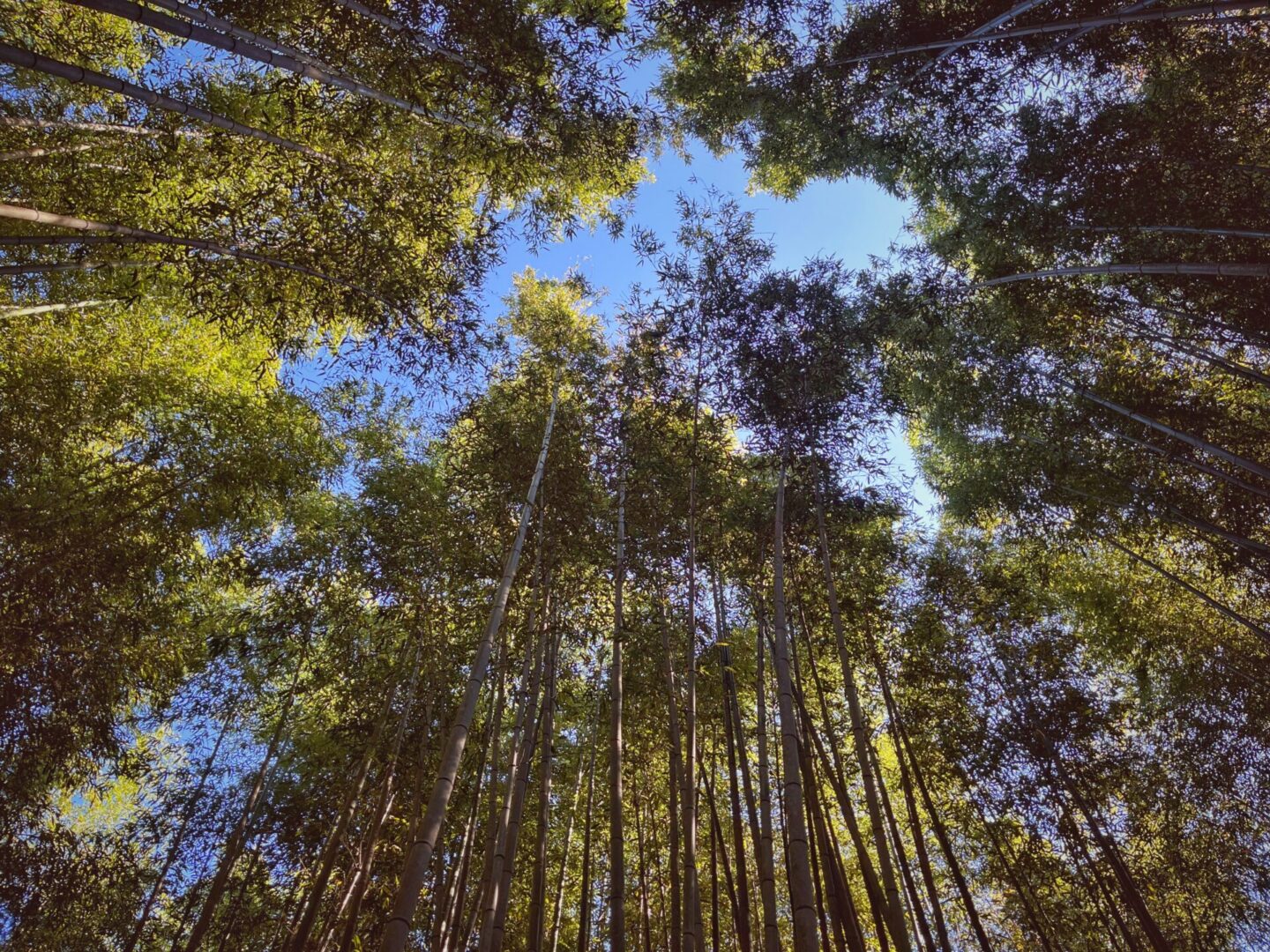
It’s time for lunch, and time to get out of the slow shuffling crowds around the entrance/exit to the Arashiyama Bamboo Forest. Rather than consulting my carefully prepared list of restaurants, we head for the first place we see that looks decent value for money. This happens to be Ueshima Coffee House Kyoto Saga Arashiyama, which by pure coincidence is actually on my carefully prepared list of restaurants. It’s a nice bright coffee shop/cafe, and we both opted for the set lunch menu which consisted of a salad, katsu curry and a drink for ¥2120 per person (around a tenner).
Kimono Forest
We feel ready to tackle the crowds again and hit the town, walking Arashiyama’s main shopping street. Its a touristy hub of souvenir shops, kimono rental stores and street food stalls. We’re heading towards the river but we take a detour to visit the Kimono Forest, located next to Arashiyama Station. It’s not an actual forest, but a unique art installation featuring cylinders wrapped in colourful and intricate kimono fabric (kyo-yuzen). The Kimono Forest showcases the artistry of traditional Japanese textiles; it’s very pretty, and meant to be even more striking when it’s illuminated at night.


Togetsukyō Bridge
We continue our stroll and pause a while on the riverside, soaking in the natural beauty, breath-taking autumn colours and mountain views. Shops, restaurants and street food trucks line the riverside, and we spend a little time watching the row boats gently bobbing on the Katsura River. Togetsukyō means “Moon Crossing”, a name bestowed on the original wooden bridge by Emperor Kameyama. We cross the river and treat ourselves to a highball at cafe and souvenir shop Arashiyama Daiichi.

It’s time to call it a day on our trip to Arashiyama. I loved the temples, Otagi Nenbutsuji and Adashino Nenbutsuji, and strolling down Saga Toriimoto Preserved Street. I didn’t love the Sagano bamboo forest or the crowds shuffling down towards the river. In order to beat those crowds once more – well, it worked this morning – we wait at the bus stop across the river. Well, Mr Fletche does. I’m still finishing a giant matcha and vanilla ice cream.
There’s quite a queue but when the bus comes we’re able to get on and claim a seat at the back quite quickly. The bus continues to fill until it’s standing room only, and barely that. We settle down for the 40 minute journey back to our hotel. I am smug again. Except just 5 minutes later we’re pulling into a bus station. Apparently there’s an issue with the bus so we need to change. First on Bus Number 1 means last on Bus Number 2. We spend the next 35 minutes crammed in like sardines, standing. I am no longer bus smug.
Arashiyama Adventures: When to Visit and Final Thoughts
It would be easy to spend a full day in Arashiyama; there are so many more shrines, temples and gardens that we couldn’t squeeze in to half a day. The views from the Arashiyama Park Observation Deck in Kameyama Park look stunning. The river cruise and romantic train look like great fun if you have a little more time. And there’s also the Arashiyama Monkey Park Itwatayama, a forested hill populated with wild Japanese macaques. Arashiyama is touristy, but hey, you’re probably a tourist too. If you make an early start you can definitely avoid the worst of the crowds.

Early mornings are the best time to visit if your main focus is photographing the bamboo forest, when it’s bathed in soft morning light. Definitely avoid the mid-morning and lunchtime rush if possible, and plan a mid-week visit if it suits your itinerary. We were there on a Sunday, at lunchtime, so probably peak rush hour 🙄. The temples and their grounds looked particularly magical with their vibrant red and orange foliage – I highly recommend November to visit Arashiyama, Kyoto and Japan in general.
Looking forward to our second day in Kyoto? Here’s what’s coming up! More temple hopping, from Ginkaku-ji to Eikan-do along the Philosophers Path. Spectacular autumn colours. Sake and snacks. Visiting the overcrowded Fushimi Inari shrine at the perfect time. Bar-hopping in Pontocho Alley.
I try my hardest to keep the information in this travel guide up to date; however if you notice anything has changed please let me know! Happy travels, Emmalene
Thank you to Mr Fletche for kindly sharing all his photos with me. The slightly fuzzy, out of focus ones are all mine 😉


What a wonderful day. The kimono forest is really pretty and quite unusual.
It really is! The girls in the kimonos looked so pretty against this backdrop too 🙂
Wow it looks incredible. Yours and Mr Fletche’s photos are stunning 🙂
Thanks Hannah! Its easy to make such a beautiful place look stunning!
I’m so glad you got to that first temple! It was on my list but we just ran out of time unfortunately as we went to Arashiyama for an afternoon. Great itinerary and great tips – I knew there were other bamboo forests in the area but I didn’t know where, so that’s good to know! It all looks amazing in autumn too.