10 Unmissable Things to See and Do in Seville in November
November is a great time for sightseeing in Seville. For a start, there’s less tourists. Yes, I know its ironic to want to be a tourist in a city but to not want suffocating crowds and shuffling people-trains through the main attractions. We found November to be pleasantly uncrowded. Of course, it’s best to pre-book tickets to attractions and get skip-the-line tickets in advance where possible. We tend to use Get Your Guide to book. From tasty tapas to fiery flamenco, there’s a host of unmissable things to see and do in Seville in November.
**This blog post may contain affiliate links. This means that if you go on to make a purchase or booking after clicking through one of my external links, then I may make a tiny bit of commission, at no extra cost to you!**
Cathedral of Saint Mary of the See
The imposing cathedral is the world’s largest Gothic church, and the third largest church in the world after St Peter’s Basilica in Vatican City and Basilica of Our Lady of Aparecida in Brazil. Originally built in the 12th century as a mosque, it was converted to a cathedral in the 13th century. Inside you can find the final resting place of several Spanish kings, and the tomb of Christopher Columbus. Yes, the ACTUAL tomb, despite many other cities laying claim to his remains.
It’s bell tower – La Giralda – towers over picturesque squares and cobbled streets. Built in 1171, it’s one of the few features which remain from the original mosque (preserved during the restoration). It has a slowly ascending spiral ramp ascending 330ft with beautiful panoramic views over Seville. Rumour has it that this was so the Muezzin could ride his horse to the top of the tower to lead the call to prayer. The Rundetaarn in Copenhagen is similar. In all honesty, if you’re taking the Rooftop Tour (see below) then you can skip La Giralda. We found it crowded and the views obstructed by fencing.
The cathedral is one of Seville’s most popular attractions so I’d highly recommend booking skip-the-line tickets well in advance. If you prefer a guided tour, this one is highly rated. On Mondays, there is a free tour of Seville Cathedral including an audio guide and access to the La Giralda Tower from 4:30 PM to 6:00 PM.


Get a birds eye view of the Cathedral on a Rooftop Tour
As well as the normal entrance ticket, there is another way to see Seville Cathedral. From above. The Cathedral Roofs Guided Tour ticket includes entrance to the cathedral, La Giralda, and the Church of El Salvador. We took this tour and thought it was worth every penny. The groups are limited to small numbers, and we were given ample time on each level – inside and outside the cathedral – to take photos and enjoy the views. The horse-drawn carriages below look like miniature toys from the top. Looking down over the cathedral rooftop you can see its iconic blue and white dome, and the Patio de los Naranjos, filled with 66 orange trees.
You can book a rooftop tour here; there are a limited number of spaces available for each time slot.


Get lost in the Barrio Santa Cruz
If you’re visiting any of the major attractions in Seville, then it’s highly likely you’ll find yourself in Barrio Santa Cruz. This is the tourist heart of the city and home to Seville Cathedral and the Royal Alcázar. It’s a maze of narrow historic streets and hidden squares, and a great place to soak up the city’s history, as well as plenty of authentic spots to eat and drink if you know where to look.
Back in the 13th century, Seville’s Jewish population were confined to this area of the city by Ferdinand III. In fact, many of the churches in this area were originally synagogues. Nowadays, it is filled with artisan stores, tasty tapas bars, flamenco shows and plenty of spots for people-watching. Predictably, where there are tourists, there are also souvenir shops; you’ll find an abundance of these if you want to pick up a trinket or two. Naturally, we picked up a Christmas decoration to join our collection from around the world.
Santa Cruz is an ideal neighbourhood to stay in for first time visitors to Seville. We stayed at the four-star Hotel Fernando III on Calle San José.


Soak up the sunshine at Parque de Maria Luisa and Plaza de España
The manicured gardens and shady pathways of Parque de Maria Luisa provide a welcome respite from the hustle and bustle of Seville. This 100 acre urban park has lakes, tropical trees, gazebos, fountains and plenty of places to sit and relax. Keep an eye – and ear – out for the green parrots! The park is also home to the Archaeological Museo if you want to find out a little more about Seville’s ancient sites and ruins.
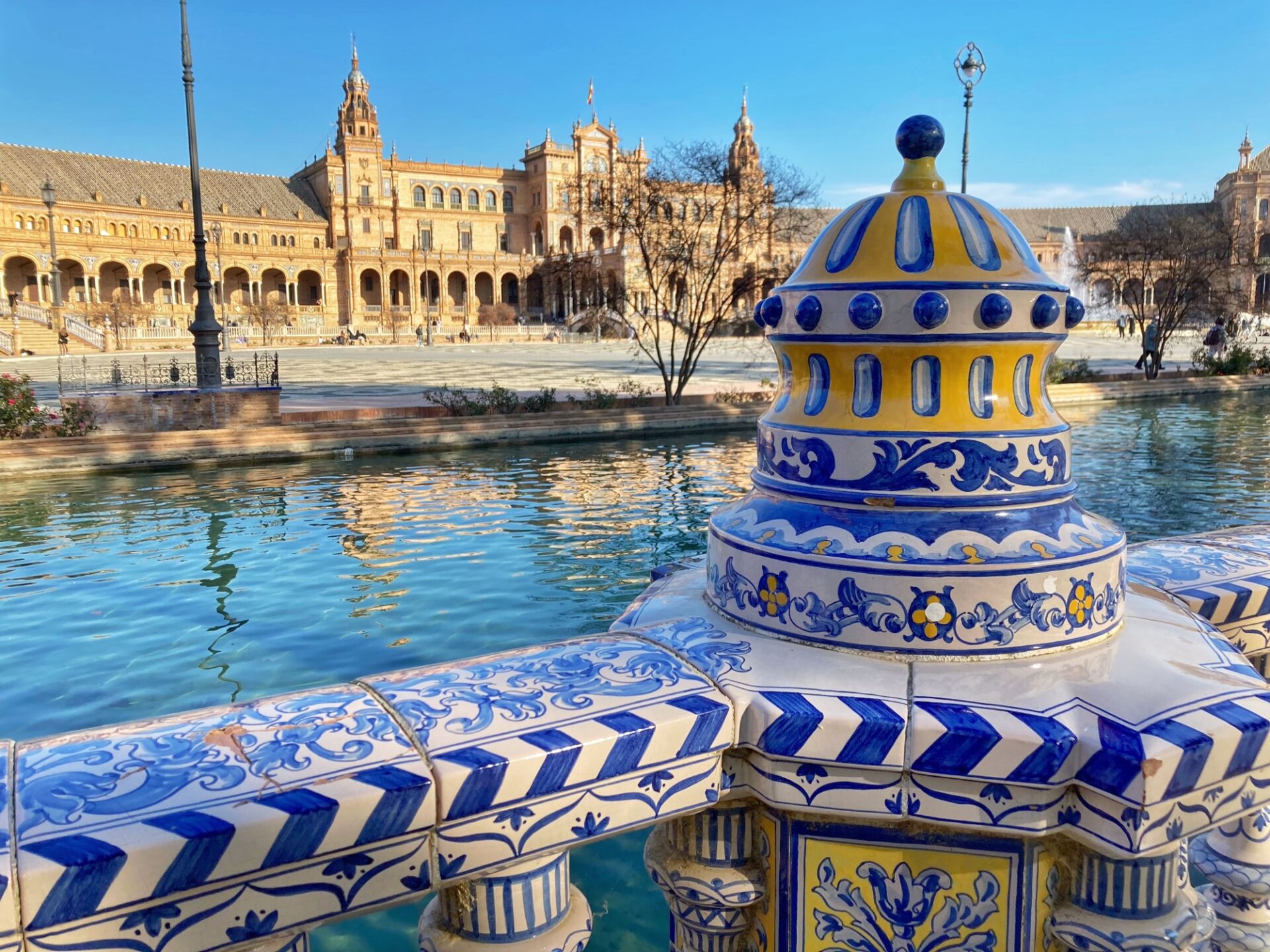
Tucked at the edge of Maria Luisa Park, the stunning Plaza de España is essential to any Seville itinerary. Built in 1928 for the Ibero-American Exposition, it is one of the most impressive plazas in Spain. The semi-circular buildings showcase a combination of Renaissance and Moorish architectural styles, and now houses Government offices.
48 small alcoves tucked within the red-bricked outer wall reflect the provinces of Spain, decorated with the intricate yellow and blue mosaic tiles (azulejo) found all over Seville. Two tall towers stand proud over the plaza and four highly decorated bridges span a picturesque canal with the Vincente Traver fountain at it’s centre. You can even rent a rowing boat. It’s no wonder that Plaza de España is often called “mini-Venice”. Street entertainers often gather here, and flamenco performances are common. It’s the perfect place to experience the grandeur and heart of Seville.
There are public toilets at Plaza de España. It’ll cost you €0,60 to, ahem, spend a penny so make sure you have change for the turnstile.



Royal Alcázar of Seville
The Royal Alcázar is one of the most spectacular sights in Seville and is an enthralling insight into the city’s colourful heritage. It dates back to the 8th century, around the time of the Moorish invasion of Seville. Islamic rulers built the citadels in the 10th century; subsequent Spanish kings added their own flourishes to become the design that we see today. This unique blend of styles is called Mudéjar. Since 1987 it has been a UNESCO World Heritage site. The palace is still in use today, and the upper floors are the official Seville residence of the Spanish royal family. For Game of Thrones fans, the Royal Alcázar will be recognisable as Sunspear, the summer home of the Martells.
Remarkable courtyards are lined with tiled floors, lace-like arches and decorated pillars. The most impressive palace is the Mudéjar Palacio de Don Pedro. Patio de las Docellas is a stunning courtyard, with a long pool in the centre which is perfect for photo opportunities. Although, it was covered in scaffolding during our visit. I preferred to take multiple photos of Mr Fletche in various doorways. The lush gardens are a verdant paradise and peacocks stroll around as if they own the place.
Note: Skip the queues and order your ticket in advance.. You may still need to queue to enter but the queue moves a lot quicker than those booking on-the-day tickets.
The Alcázar is free to enter on Mondays (from 18:00 to 19:00 from April to September, and from 16:00 to 17:00 from October to March). However it does give you limited time to explore.


Enjoy Seville’s Magic Mushrooms – Las Setas de Seville
Affectionally known as “the mushrooms of Seville” this vast wooden structure reflects a more modern Seville. Designed by Jürgen Mayer, it is claimed to be the largest wooden construction in the world. You can take the elevator to access the undulating walkway atop the Metropol Parasaol and it’s panoramic viewpoint. By day, it’s impressive – it looks a bit like a giant waffle. As night falls though, it is magical, beautifully lit with ever-changing colours and a perfectly curated soundtrack.
You can purchase tickets online or from the ticket office. Admission is €15, including a multisensory short film, Feeling Sevilla, and access to the 360° panoramic platform. Las Setas de Seville are open from 09:30am until 00:30pm every day. Make sure you take a pic with the giant Sevilla sign too!


Take a riverside stroll along the Guadalquivir River
Separating Seville’s historic centre from Triana, the Guadalquivir river spans the length of Andalucía and is Spain’s second longest river after the Ebro. On the east side there are pedestrian and cycling paths, and plenty of benches in shady areas to soak up the riverside vibe. I highly recommend a visit to Mercado Lonja del Barranco for a lunchtime or afternoon bite.
Triana is a charming neighbourhood on the west bank of the Guadalquivir River. Crossing the river at the arched Puente de Isabel II you can stroll around Mercado de Triana, where fresh produce stalls sit alongside cafes and bars. It’s the best area to pick up authentic souvenirs Triana also houses the Centro Ceramica museum dedicated to the traditional tiles (€2.10 entrance). Along this side of the river lies Calle Betis, a hub for nightlife and flamenco.
From a riverside walk it is easy to pay a visit to the 118 ft twelve-sided Torre del Oro (Tower of Gold), a 13th century Islamic watchtower. There’s a small naval museum inside and beautiful views from the rooftop terrace across the Guadalquivir river to Triana. Also close by is the Plaza de Toros de la Real Maestranza de Caballería. Bullfighting still takes place in Seville, and this is the oldest bullring in Spain, with a capacity of over 13,000. Whether you agree with the sport or not, it is part of the cultural heritage of Seville, and the season runs from February to late September. You can take a tour of the complex if you visit out of season, or simply prefer not to witness a bullfight for yourself. Tickets are €10pp; this includes an audio guide which can be downloaded to your mobile phone.


Experience an authentic flamenco show
You can’t escape flamenco in Seville, from free performances at Plaza de España to professional productions with dinner. Flamenco is everywhere, and if orange is the smell of Seville, then flamenco is its sound. It is more than a dance; it’s a feeling and an emotion. Triana is traditionally known as the gypsy neighbourhood of Seville, and is regarded as the birthplace of flamenco. Many of the bars, particularly those along the riverside Calle Betis have impromptu flamenco performances of an evening.
There are a multitude of options available if you want to book tickets for a professional flamenco show. Some venues offer a show with dinner, others focus entirely on the performance without the distraction of food and drink. Certain tablao cropped up multiple times during my research: Casa de la Memoria; Tablao El Arenal; Museo del Baile Flamenco; and El Palacio Andaluz were all popular choices. But we opted for Tablao Los Gallos, just a five minute stroll from our hotel.
You can read more about our flamenco experience in Seville here.


Spend a rainy day at Acuario de Sevilla
If it’s rainy outside, one of the best ways to spend a morning is at Acuario de Seville. The aquarium holds over 400 marine species and more than 7,000 specimens in 35 different tanks. Visitors follow a trail through the aquarium inspired by the round-the-world voyage made by Ferdinand Magellan and Juan Sebastián Elcano which started from Seville in 1519. This voyage led to great discoveries of new ecosystems, both on land and under the ocean.
It’s a perfect rainy day activity for little kids and big kids alike. It’s not so big to become boring, and there’s a small cafeteria and gift shop on site. Signage on the outside in a bit hit and miss though – we walked through one door and it looked like we were walking into an office building. Another door led us to a staircase which did luckily lead us to the aquarium’s ticket office, but we seemed to have come through the back door. It’s not the cheapest activity at €17 per adult and €12 per child aged 4 and over, however it is both fun and educational. You can purchase tickets here.


Enjoy tasty tapas on a tapas crawl
Wondering what to eat in Seville? Welcome to the wonderful world of tapas! Tapas are small portions of food, consumed as appetizers, snacks or as a main meal. Tapas are best consumed with a chilled glass of the local Cruzcampo beer. Or maybe a vina de naranja. Or a vermouth. There are over 3000 tapas bars and restaurants in Seville, so you’ll never be short of somewhere to dine. In fact, it is the done thing to order one or two small plates in one venue, and then move along to another for your next “course”. It’s actually a pretty inexpensive way to eat in Seville if you’re on a budget. Most dishes are around €3-€4 each.
You can plan a tapas crawl independently, or you can join an organised tour. We found that this 3-hour tapas walking tour was perfect for us. It was a great way to meet new people, explore less touristy areas of Seville and – most importantly – try new food! There wasn’t enough time on this trip to try ALL of the tapas bars I’d researched, but some of our favourites were La Bartola, Las Teresas, Quitapesares and Maravilla Social Club.
You can read more about our Seville Tapas Crawl here.

Looking for more things to do in Seville in November?
Planning a visit to Seville? Pin me for later!