
Best things to Do & See in Marrakech in 2 Days (And What We Skipped!)
With just two full days in Marrakech, we knew it would be impossible to see and do everything. Travelling with Ma and Pa Lee meant our travel itinerary needed to be a little less hectic than usual. Downtime was vital. Wandering around aimlessly without a plan was a no-no. Here are some of the things that we got up to during our 48 hours in Marrakech – as well as some of the things we skipped. Our first day covered central Marrakech, from Koutoubia to the Kasbah; Day 2 focused more on the northern part of the city.
**This blog post may contain affiliate links. This means that if you go on to make a purchase or booking after clicking through one of my external links, then I may make a tiny bit of commission, at no extra cost to you!**
Take a free walking tour
It will surprise no-one that we began our trip to Marrakech with a free walking tour. I didn’t fancy plunging headlong into the souks and medina without an introduction from a local. We booked this half day walking city tour of Marrakech’s medina via Guruwalk.

Our guide Mustapha took us from Koutoubia Mosque & its gardens to Marrakech’s Jewish Quarter, Mellah. He introduced us to the bustling souks, and to the art of haggling. A visit to a local pharmacy and spice emporium gave us the opportunity to sit down and sample some of the tastes and smells of Marrakech. Mustapha was a knowledgeable guide, making sure we had plenty of stops in between the walking. He shared lots of useful tips about things to do & see in Marrakech, giving us the confidence to explore the medina and souks alone.
As always with “free” walking tours, make sure you tip generously at the end! A good guide will gently encourage you to donate what you feel the tour may be worth, without putting on any pressure. “Free” tour guides are often freelance and tips could be their sole income – which means they often work harder to give you the best experience possible!
Run the gauntlet of Jemaa El-Fna Square
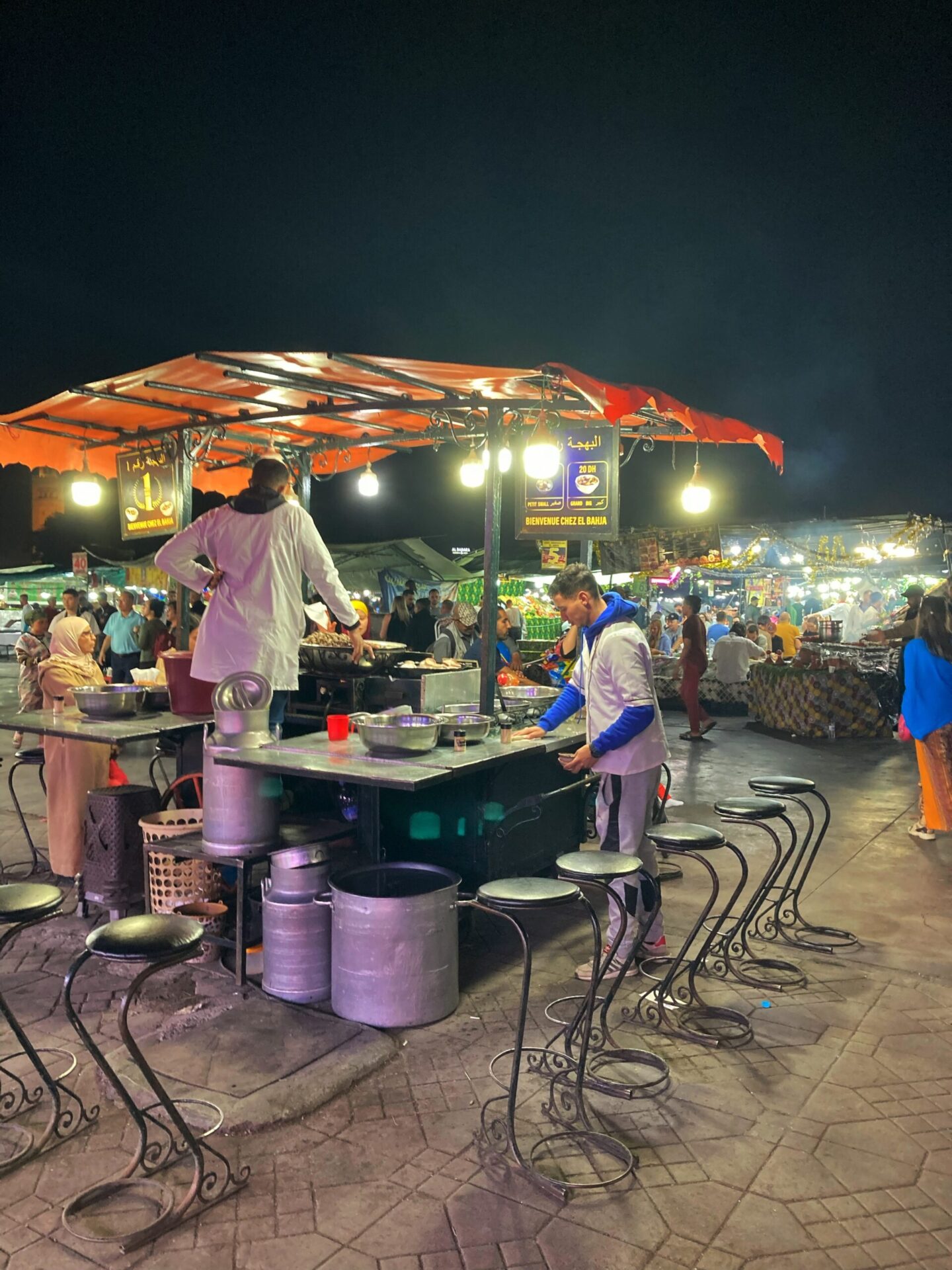
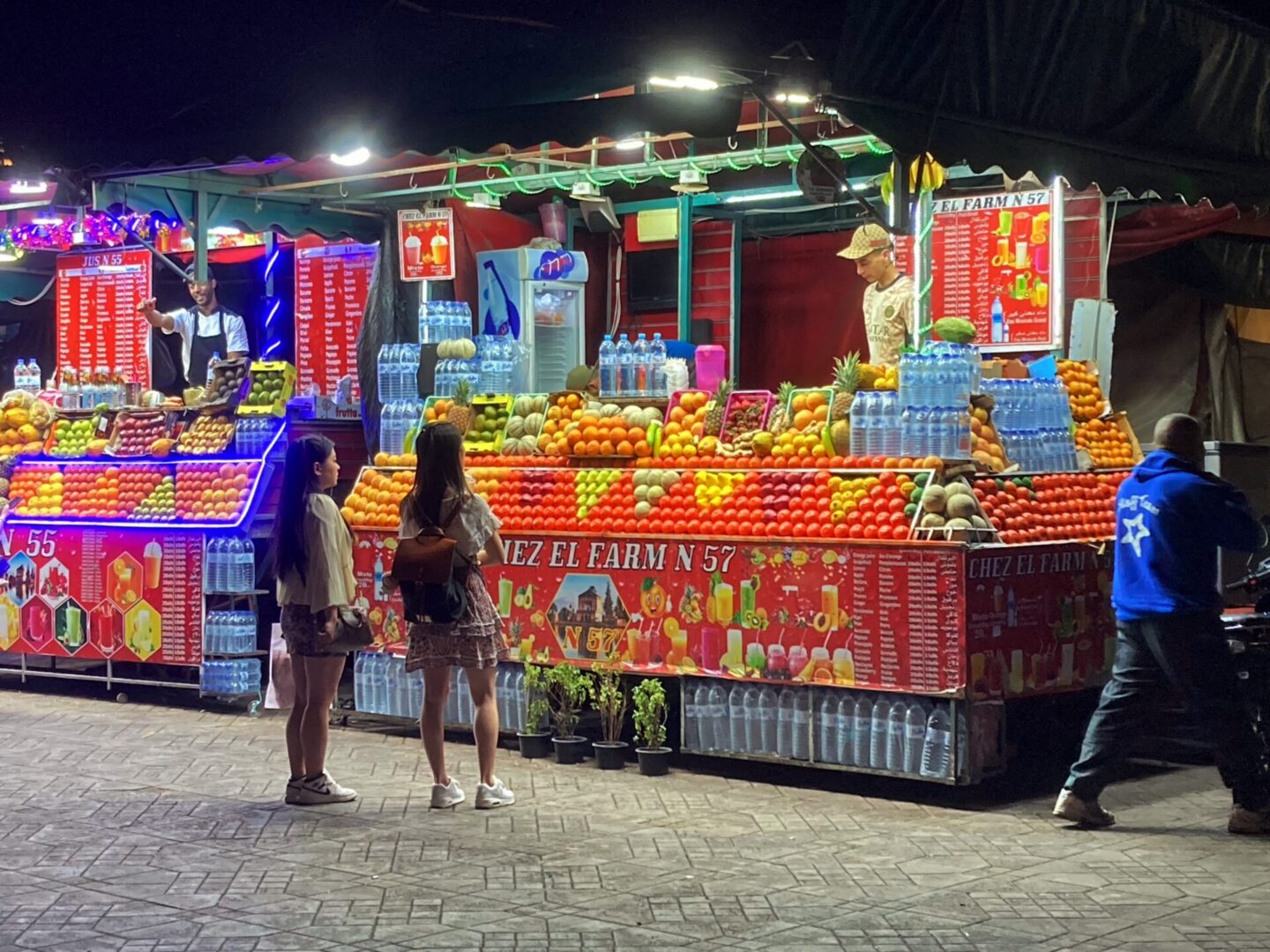
Jemaa El-Fna Square is the main gathering place of Marrekech and represents the heart of the city. Historically it was a site of public executions; now there are juice sellers, snake charmers, monkey handlers and henna artists aplenty. At sunset, clusters of food stalls pop up, transforming the area.
It may be one of the top things to do & see in Marrakech but you don’t need to linger too long here. Jemaa El-Fna Square is quite the overwhelming experience. If you don’t feel comfortable exploring alone, take a guided tour such as this one: Marrakech: Medina by Night Walking Tour with Moroccan Tea.
Love it or hate it, you can’t miss it. Here are my top tips for staying surviving Jemaa El-Fna:
- Take only the bare minimum with you in terms of cash or valuables.
- Have a few loose dirhams for performers or for any photos you may take.
- Don’t engage with locals asking if you need assistance or directions.
- Have a drink at one of the cafes or rooftop bars for the best views of Jemaa El-Fna Square without the hassle.
- Skip the snake charmers and monkey trainers; please don’t support the animal abuse practices.
- Avoid the henna artists. Some mix their tattoo ink with a black coloured dye which may cause an allergic reaction. If you want a henna tattoo, go to a reputable store, or to the Henna Cafe Marrakech
- Watch out for the motorbikes, carts, bicycles and delivery trucks around the periphery.
- Be careful taking photos featuring people. We heard tales of tourists being harassed for payment, but luckily we didn’t experience this.


Haggle in the souks
The souks are some of the most famous shopping streets in the world, and one of the top things to do & see in Marrakech. They offer everything, from ceramics to spices, lanterns to leather goods. The souk is a labyrinthine network of stalls, stretching from Jemaa el-Fna square to the Musée de Marrakech. There are multiple entrance and exit points, so you’ll never be completely trapped. Even if it sometimes feels like it. It’s easy to feel intimidated or to even wonder where to begin. Do you want to shop? Or just wander through and experience the heady aromas, noise and colours?
How to haggle
Haggling is expected in the souks. Prices are inflated to reflect that so never pay the “tourist” price. The general rule of thumb is to start with a third of the price, and then increase slightly with every counter offer. Haggling should always be light-hearted! There’s no set rule of what price you “should” pay but half of the advertised price should be considered reasonable. Have a maximum figure in mind that you’re willing to pay. If you don’t reach an agreement say a polite but firm “no, thank you” (“la, shukran“) and walk away. If your final offer is reasonable then you may find the seller is keen to close the sale.
Unless you’re intending to purchase, don’t ask the price. It’s tantamount to a contract in Marrakech and vendors can be very persuasive! Also try and have the currency conversion rate in your head before you start. Current exchange rate for GBP is 12.45 to the £1. So £10 is around 125 MAD and 100 MAD is around £8.
If you’re a serious shopper, hire a local guide to help you navigate the souks and find the best price for your purchase without any pressure. This private shopping tour via Viator comes highly rated. We were restricted in what we could purchase as we were travelling carry-on only. Small tagine-style condiment pots are carry-on friendly souvenirs. Rugs aren’t.


Sample Moroccan Cuisine
Morocco is known for its flavoursome and colourful dishes which reflect the country’s rich heritage and diverse influences. After an impromptu trip planning session at Tabule Kitchen in Moseley even Ma Lee was cautiously excited to sample a little more authentic Moroccan food.
Tagine is probably the quintessential Moroccan dish. Named after the conical clay pot it is cooked in, a tagine is a slow-cooked stew, usually made with tender meat and vegetables, flavoured with aromatic spices and served with a mountain of couscous. It’s easy to eat tagine for every meal in Marrakech; you’ll certainly find it on most menus. Every dish was accompanied by khobz, a traditional flatbread cooked in a wood fired oven and used to scoop up food
Although there are upscale restaurants and fine dining, it’s easy to eat relatively cheaply in Marrakech in casual establishments, street food stalls and cafes. If you want the best local tips, make sure you ask the hosts at your riad or your walking tour guide for their favourites. We didn’t take a street food tour this time round but they’re a great way to experience local cuisine and culture. The following food tours are highly rated on Get Your Guide and one of the top things to do in Marrakech:
Escape the chaos
If you need a break from the chaos and noise of the medina, just look up. Marrakech is well-known for its rooftop bars and restaurants, with birds eye views of the bustling streets and squares below, and across to the Atlas mountains. You can watch the hustle and bustle below in peace, with a freshly squeezed juice, strong coffee or refreshing mint tea. Many venues are dry, meaning that they don’t serve alcohol. However, if you are after something a little stronger, the following do serve alcohol:
- 🍸MK Rooftop
- 🍸Pergola
- 🍸Dar Essalam
- 🍸Cafe Arabe
- 🍸La Kabana
- 🍸Bazaar Cafe
- 🍸Dardar Rooftop
- 🍸El Fenn
- 🍸La Salama
For us Kosybar was a relaxing retreat after our walking tour; after indulging in a glass of wine we decided to make the most of this oasis with a panoramic view of Tinsmiths Square and order lunch too. (Try the pastilla here, a parcel of flaky pastry stuffed with shredded chicken and fragrant spices, and covered in powdered sugar and cinnamon. It’s like eating a main course and a dessert all at once!)

As we visited during Ramadan some venues had altered opening hours to allow staff to break their fast. Make sure you take this into account if visiting during this period.
Le Jardin Secret
Another spot to enjoy peace and tranquility is Le Jardin Secret. This “not-so-secret” secret garden is located in a historic riad and is a fully reconstructed traditional Islamic garden. It’s a perfect break from the busy medina, with plenty of benches in shady spots to sit and relax. The gardens are split into two sections; the Islamic Garden, and the Exotic Garden, filled with rare plants from all over the world.
There are restrooms available and two cafes onsite. Le Jardin Secret is open year-round from 9:30am. Closing times vary so check at their website if you’re planning an afternoon visit. Entrance is 100 MAD (£8); it is an an additional 40 MAD to access the tower (£3.20)


Immerse yourself in Moroccan architecture
Morocco has a rich architectural heritage which means plenty of beautiful buildings to explore, from grand palaces to simple mosques and traditional riads and dwellings. We enjoyed strolling around Marrakech and discovering some of the city’s gems. Even the airport is impressive!
Ben Youssef Madrasa
Founded in the 14th century, this Islamic college was one of the most prestigious in North Africa, home to up to 900 students. Now, tourists flock to the site to enjoy the colourful mosaics, the cedar woodwork and reflecting pool. Spartan dormitories are on the second floor, where intricately carved shutters flank windows which look out onto the elaborate courtyard below. This was our favourite place to visit.
Koutoubia Mosque
Koutoubia Mosque is the centre of religious life in Marrakech; the city’s largest mosque, and one of the oldest in Morocco. You’ll hear the call to prayer often during your stay – it’s hard to miss, echoing across the city. At 77m high, you can see Koutoubia’s clay-coloured minaret from almost all points in the city, making it a handy point of reference when navigating around the medina. With it’s mix of Islamic and Moorish architecture I could clearly see similarities between the minaret and La Giralda in Seville, and its continuous spiral ramp inside, wide enough for a horse-drawn carriage, reminds me of Copenhagen’s Rundetaarn.
Only Muslims are permitted to enter Koutoubia Mosque. The surrounding gardens though are open to all.
Bahia Palace
Bahia Palace is one of the best places in Marrakech to marvel at intricate mosaics, carved ceilings and elaborate tilework, and to peek into the luxurious lifestyle of the elite. Reflecting Islamic, Moorish and Andalusian styles, it showcases the opulent craftmanship of local artisans. Every corner of Bahia Palace seems to tell its own story. Built in the late 19th century at the request of Grand Vizier Si Moussa, the palace was a hub of political and social activity, hosting dignitaries and ambassadors. Over 300 women lived in the palace, including wives, servants and concubines. The addition of more and more children meant the addition of more and more rooms, contributing to the palace’s labyrinthine layout.
It’s worth mentioning though that at present (2025) some of the palace and its gardens are undergoing renovation work due to damage caused during the 2023 earthquake. Bahia Palace is located in the southern part of the Medina, and is in easy walking distance of many of the city’s central attractions. If you have time in your itinerary it’s easy to pair Bahia Palace with visits to El Badi Palace and the Saadian Tombs.


Get lost in the maze of the medina
The medina is the old walled city of Marrakech. A tangle of streets radiate from the central Jemaa el-Fna. The scent of fragrant spices waft through the narrow streets. Calls to prayer echo across the city from Koutoubia Mosque. Bright colours contrast against dusty pink walls. Everywhere you turn is another assault on the senses. We dodge donkeys pulling wagons, and motorbikes that barely slow down through tightly crowded streets.
Ancient city walls stretch almost 19km around the medina. We stop by Bab Agnaou on our walking tour, which served as the royal entrance to the medina. That’s probably why its the grandest of all the gates, with intricate carvings and Arabic inscriptions. One such inscription reads “Enter with blessing, serene people”. That’s us.
Our riad host gave us lots of useful tips for navigating the medina, yet we still got lost. Not miserably lost. Just “haven’t-we-been-this-way-before” lost. It’s a rite of passage. Rather than panicking we just decided to go with the flow, knowing we would eventually find a recognisable location to lead us back to familiar ground. And if all else fails, we knew a friendly local would point us in the right direction. For a small fee of course 😉


Enjoy the hospitality of a traditional riad
There are plenty of accommodation options in Marrakech, but I highly recommend staying in a traditional riad or dar. The word “riad” comes from the Arabic word for garden and “dar” means house. Indeed these traditional Moroccan houses often feature central courtyards, water features and peaceful relaxing areas. We found our riad a little oasis of calm away from the chaos of Marrakech. Staying in the northern part of the medina meant that we had easy access to the souks and Marrakech’s top attractions, but far enough away from the madness of Jemaa El-Fna square.
Where we stayed: Dar Nour El Houda

Things to Do & See in Marrakech – what we skipped
Three nights and two days was an ideal time for us to get a taste of Marrakech, but it meant that we needed to exclude some popular sights from our agenda.
Popular cocktail spots
Bars and restaurants that serve alcohol are few and far between in Marrakech, but they are there if you look for them. And they get booked up months before. I did manage to nab an “apero” reservation at super-popular Dardar Rooftop but after an exhausting morning we wisely used the time to rest before dinner. If you have your heart set on a particular rooftop bar or restaurant, make sure you book well in advance.
El Badi Palace & Saadian Tombs
16th century El Badi (Palace of Brilliance) is mainly ruins today but the complex hints at Marrakech’s opulent past. Today it is watched over by a family of resident storks. The Palace suffered damage in the 2023 earthquake so not all areas are currently accessible.
The Saadian tombs are an intricate resting place for members of the ancient Royal Family of Marrakech. The tombs are decorated with marble carvings under stucco arches and cedarwood ceilings. They were sealed after the fall of the Saadian dynasty, and lay hidden for centuries. In 1917 they were spotted by chance by an aerial photographer, and eventually uncovered and restored.
Each site currently costs 100 MAD (£8pp) to enter. Queues for Saadian Tombs in particular can be lengthy.
Le Jardin Majorelle & YSL Museum
Le Jardin Majorelle encapsulates the creative heritage of Marrakech. Originally created by French artist Jacques Majorelle in 1922, the gardens were purchased by fashion designer Yves St Laurent in 1980. They were restored and enhanced to become the tourist attraction that they are today. The vibrant cobalt blue and yellow buildings in particular can be found on many an Instagram post.
Le Jardin Majorelle and the YSL Museum are highly recommended, but we decided to skip as they are located a little way out of the medina, and also quite costly. It’s around £42 at the time of writing) for a combined ticket including entry to the Berber Museum. Tickets must be purchased online, with limited slots available each day.
A Hammam Experience
Marrakech is the perfect place to try a traditional hammam. A hammam is a traditional bathhouse, where locals go to cleanse their body and soul. They’re gender-separated, and involve being covered in black soap before being exfoliated by an attendant. Public hammams can be found all over Marrakech, with Hammam Mouassine being one of the most tourist-friendly.
Even if we didn’t have Ma and Pa Lee with us, I’m not sure how I’d feel about stripping naked and being vigorously scrubbed. And paying for the pleasure In public. The good news is that there are private hammams available if you prefer to keep your modesty intact, like this one which is more of a spa experience.
Sunset and camels in the Agafay desert
We had planned to finish off our Marrakech trip with a spectacular sunset trip to the Agafay Desert. Whilst I was dubious about the camel ride, I was looking forward to the dinner and fire show in a desert setting. Mr Fletche received confirmation of the meeting time and place on the morning. It was only when we returned to our riad to get ready that we discovered a new message had since been sent, bringing the tour forward by 90 minutes. Which was in 15 minutes time. There was no way we could change and get over to the meeting point – a 12 minute walk away – in time. So sadly, we made the decision to cancel.
Things to Do & See in Marrakech in 2 Days
I created an itinerary which allowed for plenty of down time, which was much needed amid the chaos of the city. This wasn’t a trip to cram full of a bucket list of things to do & see in Marrakech. Instead it was an opportunity to sample its vibrant streets, beautiful architecture and delicious food. And it leaves us plenty of things to do and see in Marrakech if we should ever return.
Marrakech Travel Blogs and Tips from A Brummie Home and Abroad
Book a tour through Get Your Guide
Book your free walking tour via Guruwalk
Find accommodation with Booking.com
Check Skyscanner for flights
I try my hardest to keep the information in this travel guide up to date; however if you notice anything has changed please let me know! Happy travels, Emmalene


A lovely guide to Marrakech – I really enjoyed visiting the city and loved the architecture.
Great article! You’ve covered all the key points about visiting Marrakech — really well done. I also run a blog that focuses entirely on Marrakech, and if it’s okay with you, I’d love to share it with your audience too.
https://www.marrakechinmorocco.com
thank you
Great guide! If you have an extra 2 days, I’d highly recommend heading to the Merzouga Sahara Desert. Watching the sunset and sunrise over the dunes, enjoying a camel trek, and spending a night under the stars is an unforgettable Moroccan experience.
https://upmoroccotours.com/trip/2-day-marrakech-to-merzouga-desert-tour/
Definitely an excursion to consider if we return to Marrakech!